Choosing the right neighborhood is the single most important decision you'll make as a Huntsville real estate investor. Buy in the wrong area, and you'll face chronic vacancies, difficult tenants, and disappointing returns. Buy in the right neighborhood, and you'll enjoy strong cash flow, reliable appreciation, and tenants who stay for years.
After analyzing hundreds of investment property transactions across Huntsville and Madison County, we've identified the five neighborhoods that consistently deliver the best returns for investors based on actual rental data, historical appreciation rates, and boots-on-the-ground property management experience.
Important: Understanding Projections & Data
This guide contains financial projections based on historical Huntsville market performance, current rental rates (February 2026), and standard investment assumptions. These are illustrative estimates, not guarantees. Your actual results will vary based on specific property purchased, financing obtained, management efficiency, and market conditions.
All investors should verify rental rates with local property managers, obtain actual financing quotes, conduct thorough inspections, and consult with financial, legal, and tax professionals before purchasing. Real estate investment carries risk, including potential loss of principal.
How We Evaluate Investment Neighborhoods
We analyze each area based on six factors:
1. Cap Rate: Net Operating Income ÷ Purchase Price (typical range: 4.5-6.5%)
2. Appreciation Potential: Based on NeighborhoodScout data and Federal Reserve House Price Index. Huntsville averaged 7.6% over the past decade, now normalizing to 3-6% annually.
3. Tenant Quality: Income levels, lease length, school ratings from GreatSchools.org
4. Vacancy Rates: While apartment vacancy hit 19.2% in 2024, single-family homes maintain 4-7% vacancy rates.
5. Management Complexity: Time, maintenance frequency, turnover patterns
6. Projected Total Return: Cash flow + appreciation + principal paydown + tax benefits (typically 12-20% annually)
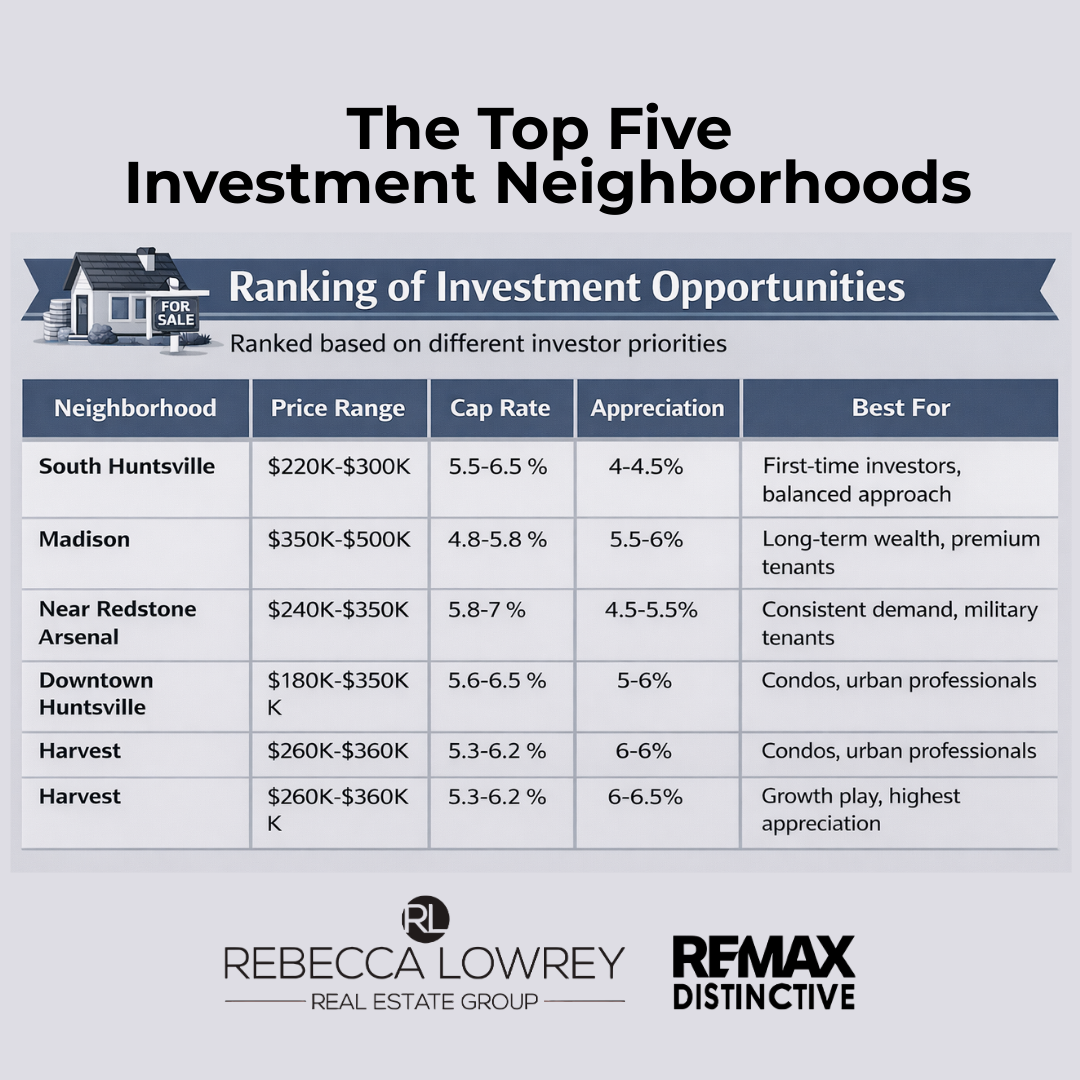
1. South Huntsville: The Balanced Entry Point
Best for: First-time investors, balanced approach
Quick Stats:
Purchase: $220K-$300K
Rent: $1,600-$1,900/month*
Cap rate: 5.5-6.5%
Projected total return: 13-16%
Verify current rates with property managers
The Opportunity
South Huntsville offers affordable entry for single-family homes with solid cap rates. Working professionals earning $50K-$75K and small families provide stable 2-3 year tenancies. Properties built in the 1970s-2000s range from 1,200 to 1,800 square feet.
Example: $280,000 property
Monthly rent: $1,750
Monthly expenses: $2,355
Cash flow: -$605/month
Total return: ~13% (includes appreciation, principal paydown, tax benefits)
With 7.5-8.5% interest rates, expect negative monthly cash flow. Budget 6-12 months reserves.
Pros: Higher cap rates, lower entry cost, strong rental demand, good balance
Cons: Moderate appreciation, higher turnover, and older homes need more maintenance
Strategy: Target properties under $270K near good schools. Avoid major system replacement needs.
2. Madison: The Premium Appreciation Play
Best for: Long-term wealth building, out-of-state investors
Quick Stats:
Purchase: $350K-$500K
Rent: $2,000-$2,600/month*
Cap rate: 4.8-5.8%
Projected total return: 17-20%
The Opportunity
Madison delivers the best combination of appreciation and tenant quality. Madison City Schools rank 8-9 out of 10, attracting professional families ($90K-$140K income) who stay 3-4 years. Predominantly newer construction (2000-present).
Example: $400,000 property
Monthly rent: $2,400
Monthly expenses: $3,344
Cash flow: -$944/month
Total return: ~17-18% (strong appreciation drives returns)
This is NOT a cash flow play. Budget for $800-1,000/month negative cash flow. Requires 7-10+ year hold and 12-18 months of reserves.
Pros: Strongest appreciation, premium tenants, lowest vacancy (4-5%), minimal turnover, newer construction, excellent for out-of-state
Cons: Higher capital required ($100K+ down), lower cap rates, negative cash flow, higher property taxes (0.40% vs. 0.33%)
Strategy: Focus on post-2010 construction near Madison City Schools. Accept negative cash flow for superior appreciation.
3. Near Redstone Arsenal: The Military Demand Play
Best for: Investors comfortable with turnover, consistent demand, and focus
Quick Stats:
Purchase: $240K-$350K
Rent: $1,800-$2,200/month*
Cap rate: 5.8-7%
Projected total return: 14-19%
The Opportunity
Redstone Arsenal employs 40,000+ people, creating built-in rental demand. Military tenants (officers, DoD civilians, contractors) generally maintain good rental history but expect turnover every 2-3 years with PCS cycles.
Example: $290,000 property
Monthly rent: $1,950
Monthly expenses: $2,482 (includes 7% vacancy)
Cash flow: -$532/month
Total return: ~15-17%
Budget $1,500-2,500 every 2-3 years for turnover costs. Upside: re-leasing typically takes 2-3 weeks due to constant military rotations.
Pros: Consistent demand, strong cap rates, quick re-leasing, BAH guarantees rent, recession-resistant
Cons: Higher turnover, more frequent turnover costs, wear from frequent moves
Strategy: Check BAH rates and target properties that rent at or below BAH. Focus on homes appealing to officers and senior enlisted (E-6+).
4. Downtown Huntsville: The Urban Professional Play
Best for: Condo investors, urban lifestyle focus
Quick Stats:
Purchase: $180K-$350K (condos/townhomes)
Rent: $1,400-$1,900/month* (2BR)
Cap rate: 5-6.5%
HOA fees: $250-$500/month (critical!)
The Opportunity
Downtown's Big Spring Park revitalization and MidCity development attract young professionals (25-40) earning $65K-$95K who prioritize walkability and lifestyle.
Critical Warning
HOA fees of $250-500/month ($3,000-6,000/year) dramatically impact returns. Always factor HOA fees into analysis BEFORE making offers.
Example: $220,000 condo with $350/month HOA
Monthly rent: $1,600
Monthly expenses: $2,122 (includes HOA)
Cash flow: -$522/month
Total return: ~14-16%
Pros: Urban appreciation (5-6%), lower entry price, less exterior maintenance
Cons: HOA fees reduce cash flow, higher vacancy (6-8%), rental restrictions, special assessment risk, narrower tenant pool
Strategy: Only invest if: (1) HOA reserves are healthy (3+ months operating expenses), (2) No rental caps above 30%, (3) Low special assessment history, (4) You accept appreciation drives returns, not cash flow.
Red flags: Deferred maintenance, low HOA reserves, rental restrictions, owner-occupancy below 50%
5. Harvest: The Highest Appreciation Growth Play
Best for: Growth-focused investors, long-term appreciation strategy
Quick Stats:
Purchase: $260K-$360K
Rent: $1,800-$2,200/month*
Cap rate: 5.3-6.2%
Projected total return: 18-22%
The Opportunity
Harvest has transformed from an agricultural area into a legitimate investment market delivering the strongest appreciation growth (~6-6.5% vs. 4-5% in established areas). Young families and middle-income professionals ($70K-$95K) commute 15-20 minutes to Arsenal for more affordable housing than Madison.
Example: $310,000 property
Monthly rent: $2,000
Monthly expenses: $2,619
Cash flow: -$619/month
Total return: ~19-20% (strong appreciation drives returns)
This is a growth bet—banking on Harvest continuing to develop over 7-10 years. Requires holding through negative cash flow.
Pros: Strongest appreciation growth, more affordable than Madison, newer construction (post-2005), solid cap rates, family-oriented, good schools
Cons: Still developing amenities, longer commute (25-30 min), less established track record, limited property management options
Strategy: Focus on post-2015 subdivisions with established HOAs near Highway 53/72 corridors. Avoid properties with well/septic or too far from main roads.
How to Choose Your Investment Neighborhood
For Cash Flow: South Huntsville (under $260K). With current rates, positive cash flow requires purchasing under $250K or 30%+ down.
For Appreciation: Harvest (6-6.5%) or Madison (5.5-6%). Accept $600-1,000/month negative cash flow. Must hold 7-10+ years. Maintain 12-18 months reserves.
For Out-of-State: Madison or South Huntsville with strong property management. Prioritize newer construction, long-term tenants, and professional management infrastructure.
For First-Time Investors: South Huntsville ($250K-$280K). Lower price limits risk while learning. Need $70K-80K liquid minimum.
For Consistent Demand: Near Redstone Arsenal. Built-in demand from 40,000+ employees. Accept higher turnover for the security of the tenant pipeline.
Critical Investment Principles
Understand Total Return vs. Cash Flow
With 7.5-8.5% rates, most properties above $280K show negative monthly cash flow ($500-900/month). This doesn't make them bad investments.
Example total return:
Cash flow: -$8,400/year
Principal paydown: +$3,500/year
Appreciation (5%): +$15,000/year
Tax benefits: +$2,000/year
Total: $12,100 = 15.1% on $80K invested
Your wealth comes from appreciation and principal paydown, not monthly checks. Budget 6-12 months reserves per property.
Budget Realistically
Use these percentages:
Property management: 10%
Maintenance: 1.5-2% of property value
Vacancy: 5-8%
Property tax: 0.33-0.40% (Madison County)
Insurance: 0.4-0.6%
HOA: Add actual fees
Never Skip Inspection
Budget $500-700 for a professional inspection. Protects from $15K-25K+ hidden issues. Investment properties need MORE thorough inspection—you won't live there to notice developing problems.
Verify Rental Rates
Call 2-3 property managers: "What would a 3BR/2BA in [neighborhood] rent for today?" Get estimates in writing. Don't trust the seller's claims or online calculators.
Property Management for Out-of-State
8-10% of rent + leasing fees is non-negotiable if you live outside Alabama. Worth it for professional screening, maintenance coordination, and legal compliance.
Maintain Adequate Reserves
$10K-15K per property minimum covering:
Negative cash flow (6-12 months)
Major repairs (HVAC, roof, water heater)
Extended vacancy
Turnover costs
2026 Market Conditions
Current Reality:
Inventory up 27.6% from 2024
Homes spend 42 days on the market
Appreciation: 3-6% (vs. 10%+ in 2021-2022)
What this means: More negotiating power, inspection contingencies standard, reasonable due diligence timeframes, and less competition.
Interest Rates: 7.5-8.5% for investment properties. Buying now locks in prices. Refinancing option when rates drop improves cash flow.
Apartment Oversupply = Single-Family Opportunity: 7,000+ apartments completed in 2024. Single-family investors face minimal new construction competition. Families with children strongly prefer single-family homes.
Getting Started: Your Next Steps
1. Define Criteria: Maximum purchase price, acceptable returns, cash flow tolerance, target neighborhoods, investment timeline (7-10+ years recommended)
2. Get Pre-Approved: Need 20-25% down, 680+ credit (740+ ideal), proof of reserves, documentation of existing rental income if applicable. (Fannie Mae guidelines)
3. Assemble Team: Real estate agent experienced with investments, property manager, lender, inspector, CPA, attorney (optional)
4. Analyze Properties: Calculate cap rate, cash-on-cash return, and total return. Use conservative assumptions: 10% management, 2% maintenance, 6% vacancy. Verify rental rates with managers.
5. Due Diligence: Professional inspection ($500-700), title search, HOA review if applicable, verify taxes (Madison County), research crime (CrimeReports.com), check schools (GreatSchools.org)
Frequently Asked Questions
Which neighborhood has the best ROI?
Depends on goals: Harvest (18-22% projected total return, highest appreciation), Madison (17-20%, best balance), South Huntsville (13-16%, best for first-time investors).
Can I achieve positive cash flow in 2026?
Possible with properties under $260K or 30%+ down. Properties above $300K will show negative cash flow with 25% down at current rates.
Is Huntsville still good for investment?
Yes for 7-10+ year holds. Strong fundamentals: 8,200 new jobs in 2024, population up 19.4%, stable economy (Redstone Arsenal, NASA), healthy 4-6% appreciation.
Condos or single-family?
Single-family generally better: broader tenant pool, higher appreciation, no HOA complications, easier resale. Only invest in condos if you accept that HOA fees significantly reduce cash flow.
How much money to start?
Minimum $60K-70K liquid (down payment + closing + reserves). Comfortable: $80K-100K. Ideal for premium neighborhoods: $120K-150K.
Need to visit Huntsville?
No—many invest remotely using live video tours, professional inspections, e-closing, and local property management. Visiting helps understand neighborhoods firsthand.
Work With Investment Property Experts
At Rebecca Lowrey Group (RE/MAX Distinctive), we specialize in investment property analysis—not just residential sales. We run cap rate calculations, verify rental rates with property managers, and provide referrals to vetted property management companies. Many of our clients invest from out of state.
Our process: Investment consultation → neighborhood strategy → property analysis → property manager introduction → due diligence support → closing coordination → post-close support
Ready to analyze your first Huntsville investment? Schedule a free consultation. We'll help identify neighborhoods matching your goals, run financial projections on specific properties, connect you with managers and lenders, and create a personalized strategy.
Megan Salem| Rebecca Lowrey Group | RE/MAX Distinctive
Serving Huntsville, Madison, North Alabama, and the Tennessee Valley
Investment Risk Disclosure: Real estate investment involves substantial risk, including potential loss of principal. All projections are forward-looking estimates based on historical data and current assumptions. Actual results vary significantly. This guide is for educational purposes only and does not constitute investment, financial, legal, or tax advice. Always conduct independent due diligence and consult with qualified professionals before investing. Market data and projections are current as of February 2026. Cap rates, appreciation rates, and returns are estimates for comparison. Rental rates based on property manager consultation—verify before purchasing. Always consult financial, legal, and tax professionals.