Investing in Huntsville real estate from out of state has become one of the most effective wealth-building strategies for investors nationwide. While coastal investors watch their $800,000 purchases barely break even, that same capital in Huntsville can acquire 2-3 cash-flowing properties with strong appreciation potential.
After helping hundreds of out-of-state investors successfully purchase Huntsville properties—from tech workers in San Francisco to retirees in Florida to active military stationed overseas—we've identified the exact systems, team members, and strategies that separate successful remote investors from those who struggle.
This is the proven process we use to help investors from 40+ states build profitable Huntsville portfolios without setting foot in Alabama until closing day.
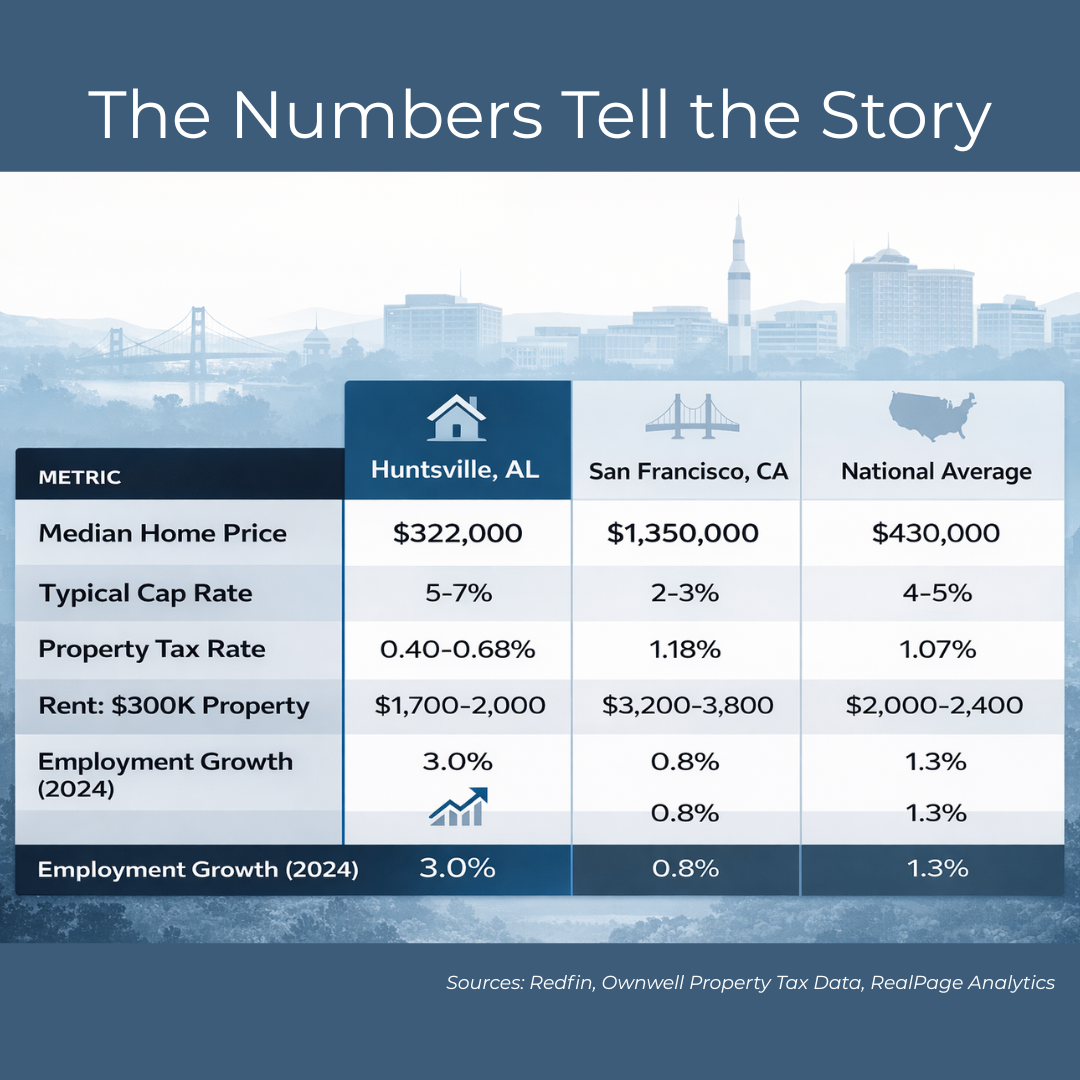
Sources: Redfin, Ownwell Property Tax Data, RealPage Analytics
Huntsville’s numbers are what initially attract most investors.
But the real advantage is how easy the market is to navigate remotely when you understand the process and build the right local team.
In this quick overview, we explain how out-of-state investors successfully purchase property here without living in Alabama.
The Economic Foundation
Huntsville's economy is anchored by Redstone Arsenal (40,000+ employees), NASA's Marshall Space Flight Center, Cummings Research Park (second-largest in the U.S.), and Mazda Toyota Manufacturing ($2.3 billion investment, 4,000+ jobs).
In the year ending April 2024, Huntsville added 8,200 jobs, expanding employment 3%—more than double the U.S. average of 1.3%. (RealPage Analytics)
This creates recession-resistant rental demand. Government contractors and aerospace engineers don't stop paying rent during downturns. Military personnel receive guaranteed BAH. Defense spending remains stable regardless of economic cycles.
Why Remote Investing Works Here
1. Professional property management infrastructure exists. Unlike emerging markets, Huntsville has multiple experienced companies managing hundreds of properties each.
2. The market moves more slowly than coastal markets. Properties average 42 days on market vs. 10-15 days in hot markets, giving you time for proper due diligence without pressure.
3. Neighborhood consistency matters more than micro-location. Madison is Madison, South Huntsville is South Huntsville. Quality agents can effectively represent you remotely because one-block variations matter less.
The Remote Buying Process: 8-Week Timeline
Weeks 1-2: Foundation Building
Week 1:
Investment consultation (virtual, 45-60 minutes)
Define criteria (budget, goals, timeline, risk tolerance)
Get pre-approved with an investment property lender
Identify 2-3 target neighborhoods
Week 2:
Interview property managers (video calls with 2-3 companies)
Review property management agreements and fees
Verify rental rates with managers for target neighborhoods
Set up a document sharing system
Critical insight: Most remote investors start by looking at properties. Wrong. Build your team first—especially your property manager relationship. Properties come and go. The right property manager determines your success for years.
Weeks 3-5: Property Search
Daily email alerts for matching properties
Live video walkthroughs (15-20 minutes each)
Neighborhood video tours at different times of day
Property-specific rental rate validation in writing
What sets successful remote buyers apart: They request neighborhood videos multiple times. A 2 pm Tuesday video looks different from a 6 pm Friday. We drive areas during both to show traffic patterns, noise levels, and activity.
Weeks 6-7: Under Contract & Due Diligence
Inspection Period (Critical):
The inspector conducts a video walkthrough (you watch live or recorded)
We attend the inspection, send photos/videos in real-time
Contractor estimates for any issues
Negotiate repairs or price adjustment
The due diligence difference: We check things cameras miss: Does the HVAC blow cold? Is there water pressure upstairs? Do doors and windows operate smoothly? Does the garage door work? These details don't show up in reports but matter for tenant experience.
Week 8: Closing & Handoff
Closing options for remote buyers:
Mobile notary - Comes to you anywhere ($75-150)
Digital closing - Sign electronically (increasingly common)
Mail-away closing - Overnight documents
Property manager handoff: We don't just toss keys and disappear. We attend the property manager's walkthrough, ensure documentation is thorough, and verify they have everything needed (garage openers, mailbox keys, HOA info, gate codes).
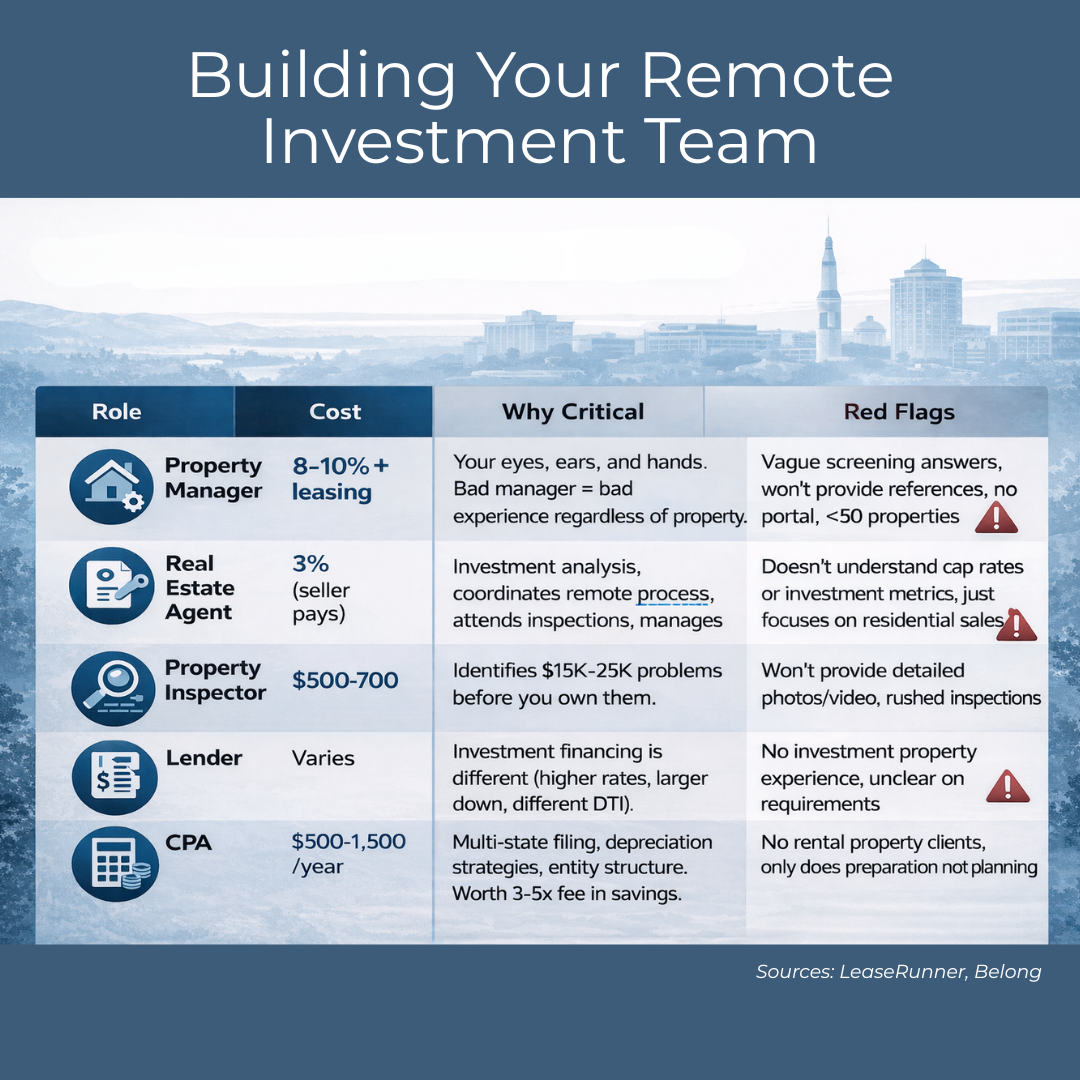
Property management fees typically range from 8%–12% of monthly rent, often with an additional tenant placement fee, according to industry sources like LeaseRunner and Belong.
Property Manager Selection: 30 Critical Questions
Non-Negotiable Requirements:
Manages 50+ properties minimum
Written tenant screening criteria
Online owner portal (24/7 access)
Proper licensing and insurance
3+ current owner references
Responds within 24-48 hours during vetting
Key Interview Questions:
Company Background:
How many properties do you currently manage?
How many single-family homes specifically?
What percentage in my target neighborhood?
Can you provide 3 current owner references?
Tenant Screening:
Walk me through your exact screening criteria
What's your minimum credit score?
How do you verify employment and income?
What's your tenant retention rate?
Leasing Performance:
Average days to lease a property?
Current portfolio vacancy rate?
How do you market properties?
Financial Management:
When do owners receive rent payments?
What's included in monthly statements?
How are security deposits held? (must be a separate trust account)
Do you provide year-end tax documentation?
Maintenance:
How do you handle after-hours emergencies?
What repair amount requires owner approval?
Do you mark up maintenance costs? How much?
Communication & Contract:
Response time to owner inquiries?
Do you have an online portal? Can I see a demo?
What's your complete fee structure?
Contract length and termination requirements?
Green flags: Detailed written screening criteria provided unprompted, low portfolio vacancy (under 6%), fast leasing (<21 days), responsive during vetting, transparent about challenges.
We've worked with every major property management company in Huntsville. We know which ones return calls, which ones nickel-and-dime owners, which handle military tenants vs. professional families, and which manage maintenance efficiently. This isn't information you'll find on Google—it comes from years of watching them operate with our clients.
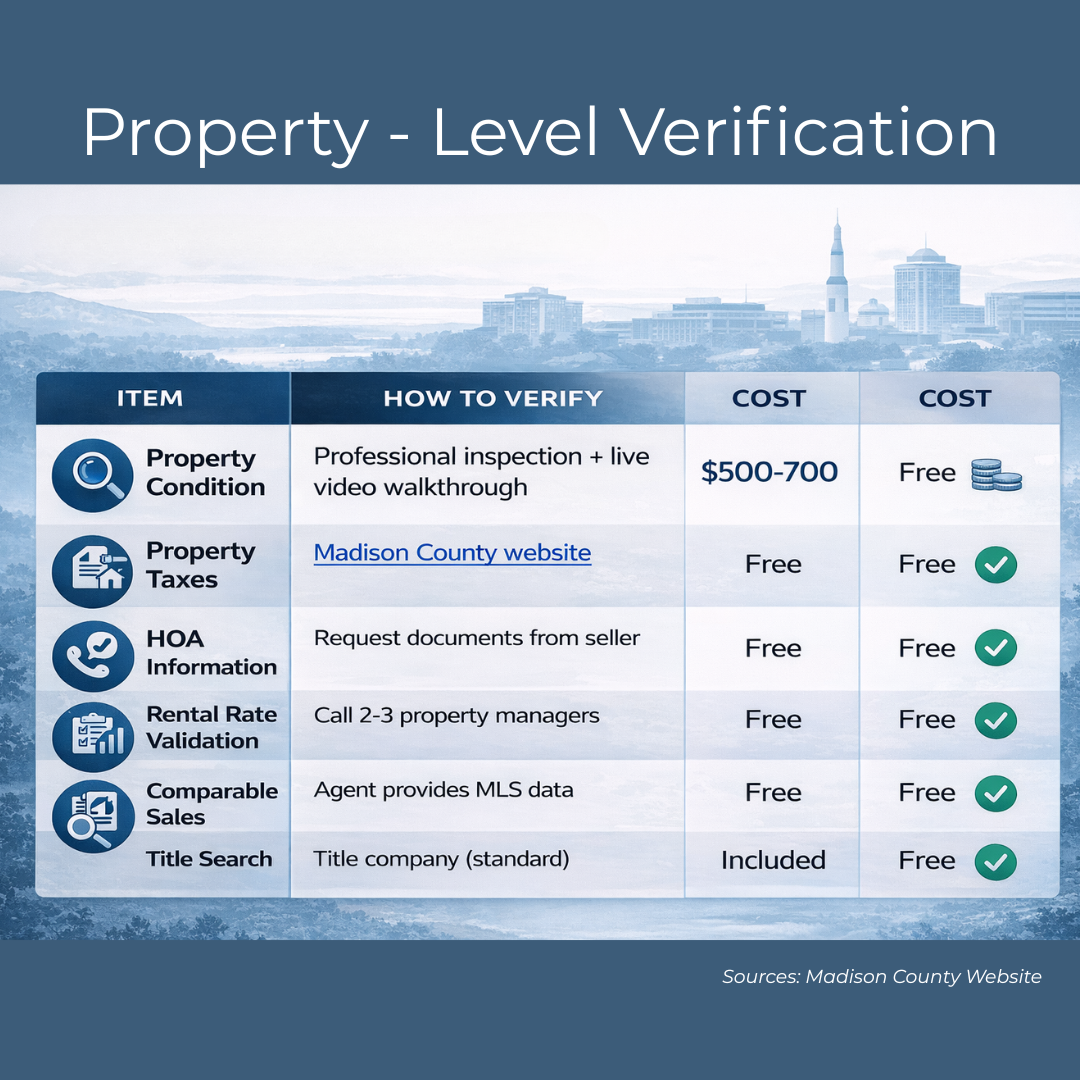
Sources: Madison County website.
Neighborhood-Level Research
Crime Statistics: CrimeReports.com
School Ratings: GreatSchools.org
Employment Access: Google Maps + traffic apps for commute times to Redstone Arsenal
Neighborhood Video Tour: Agent drives the area via FaceTime/Zoom at multiple times
Development Pipeline: City planning website + agent knowledge
The Video Walkthrough Checklist
When we conduct live property tours, we systematically cover:
Exterior (all four sides)
Roof condition (visible from ground)
Foundation (cracks or settling)
HVAC exterior unit (age, condition)
Every room (walls, floors, ceilings)
All appliances (we turn them on)
Plumbing fixtures (we run water)
Windows and doors (we open/close them)
Attic access if available
We're looking for what sellers hide: fresh paint over water stains, strategically placed furniture covering damage, and air fresheners masking odors. Twenty minutes of systematic video saves thousands in post-purchase surprises.
Alabama Tax Considerations
Multi-State Tax Filing Requirements
You MUST file Alabama state taxes if you own rental property in Alabama, regardless of where you live.
Example: A California resident owns a Huntsville rental
Must file:
Federal return (Schedule E for rental income)
Alabama return (rental income sourced to Alabama)
California return (reports all income, including Alabama)
California gives credit for Alabama taxes paid (avoids double taxation). Net effect: You pay approximately your home state's rate.
Alabama State Income Tax:
Graduated brackets: 2% to 5%
Top rate (5%) applies to income over $3,000
Most rental income is taxed at 5%
Alabama allows a deduction for federal income tax paid (unique)
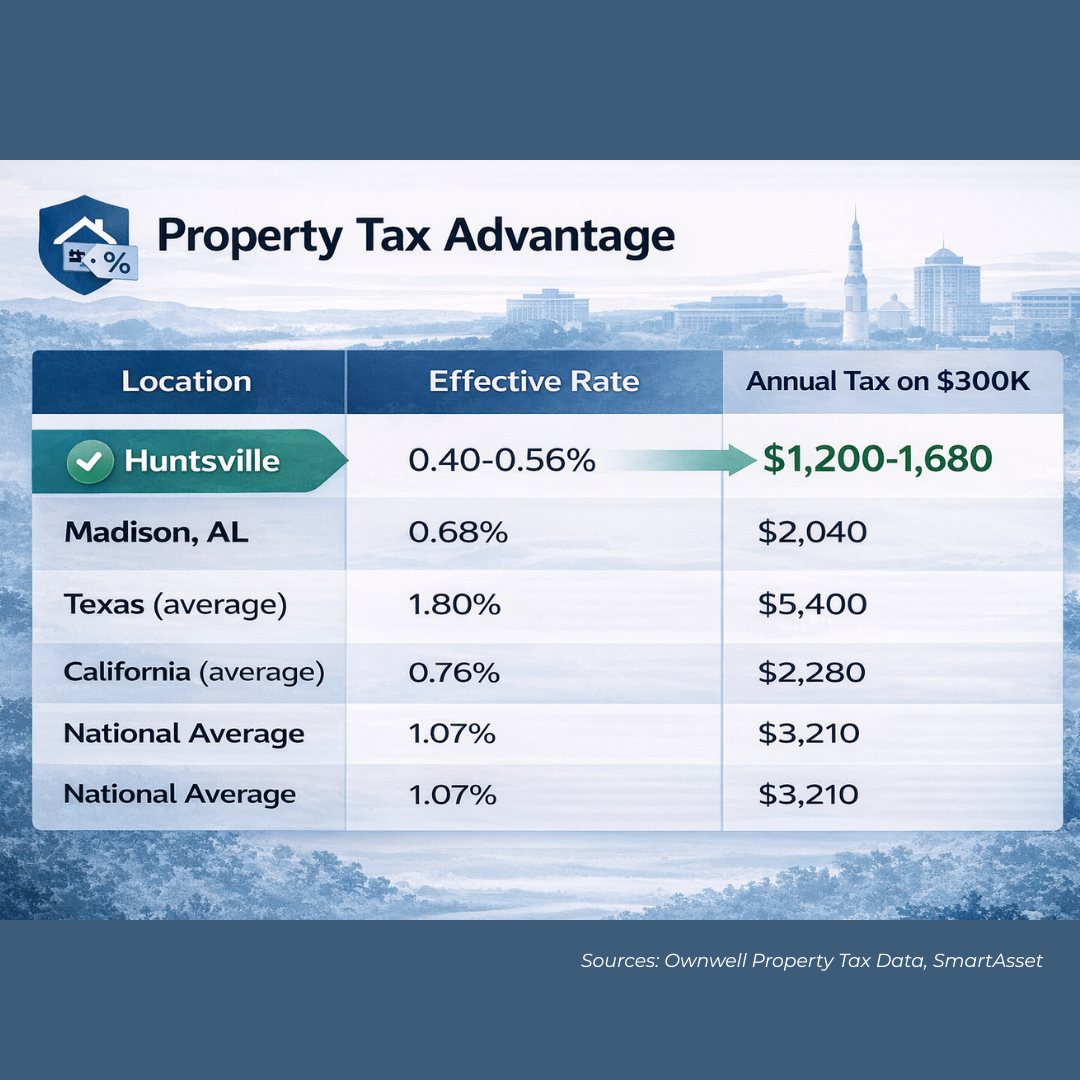
Sources: Ownwell Property Tax Data, SmartAsset
Property tax structure:
Properties assessed at 10% of market value
Tax rate applied to assessed value (not full market value)
$300,000 property = $30,000 assessed value × rate = $1,200-2,040 annual tax depending on location
Investment properties do NOT qualify for a homestead exemption
This is a massive advantage. A $300,000 property in Texas costs $5,400/year in property taxes vs. $1,200-1,680 in Huntsville—that's $3,700-4,200 annually difference, or $308-350/month in improved cash flow.
Depreciation: Your Most Powerful Tax Benefit
How it works:
Residential rental: 27.5-year straight-line depreciation
Only structure depreciates (not land)
Example: $300,000 purchase, $60,000 land = $240,000 depreciable
Annual depreciation: $240,000 ÷ 27.5 = $8,727/year
Tax savings:
25% bracket: $8,727 × 25% = $2,182 saved annually
Over 10 years: $21,820 in tax savings
Always take depreciation. Don't let fear of recapture prevent $2,000+ annual tax savings.
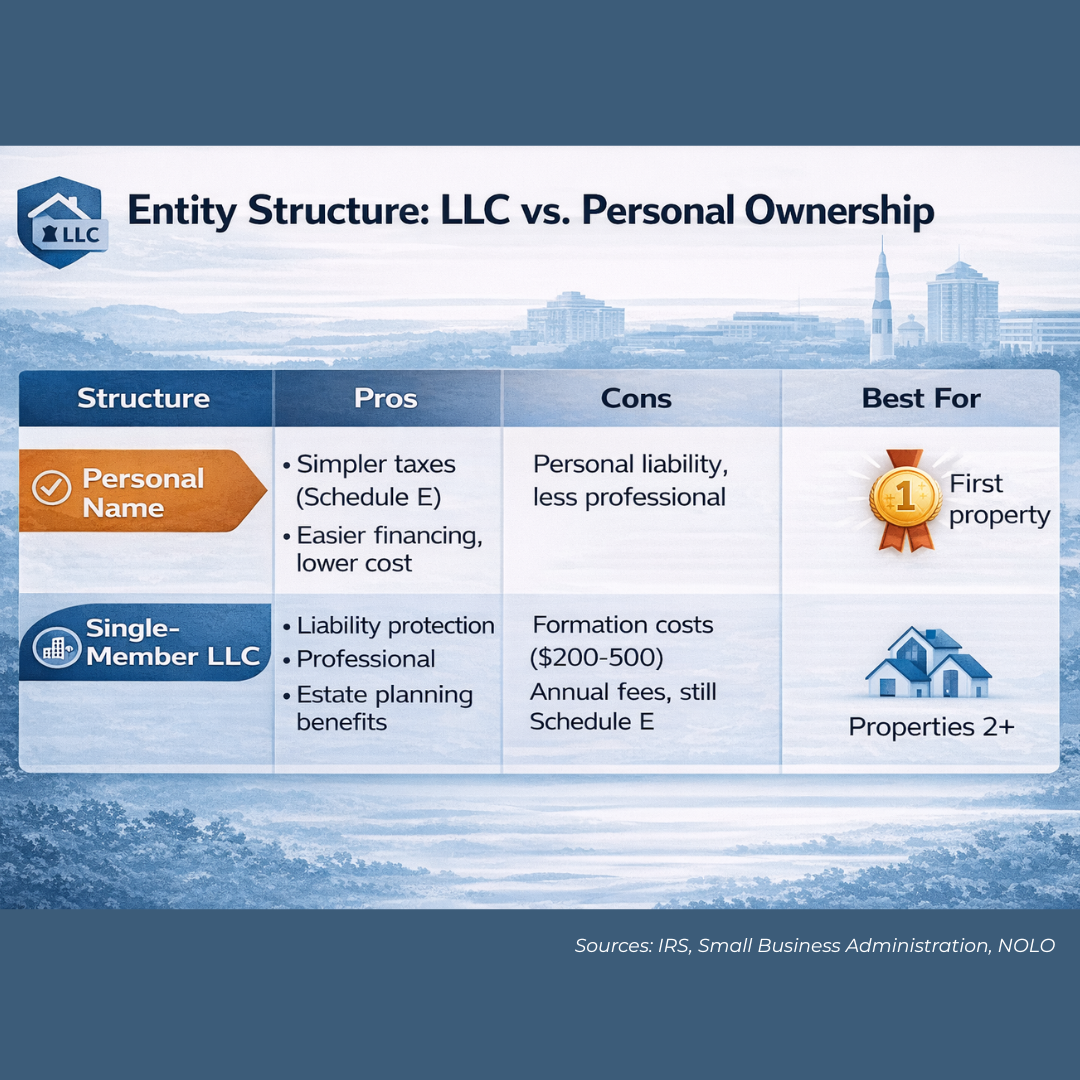
According to the IRS and Small Business Administration, rental income for properties owned personally or through a single-member LLC is typically reported on Schedule E, while LLCs provide liability protection that separates business assets from personal assets.
Common Out-of-State Investor Mistakes
Mistake #1: Choosing a Property Manager by Lowest Fee
The mistake: Selecting 7% company over 10% to "save money."
Why costly: That 3% difference ($51/month on $1,700 rent) is meaningless if the manager takes 60+ days to lease (costs $1,700+ lost rent), places bad tenants (costs $15,000-25,000), or responds slowly to maintenance.
The fix: Choose based on screening quality, average days-to-lease, communication, and references—not fee percentage. Best managers cost more but deliver 3-5x better results.
Mistake #2: Skipping Property Inspection
The mistake: Waiving inspection to "save $600."
Why costly: That $600 protects you from a $15,000 roof, $8,000 HVAC, $5,000 plumbing, $3,000 electrical, or foundation problems costing tens of thousands.
The fix: ALWAYS include an inspection contingency. ALWAYS hire a professional inspector. ALWAYS attend virtually.
Mistake #3: Trusting Seller's Rental Claims
The mistake: Believing "this easily rents for $2,000/month" without verification.
Why costly: Overestimating rent by $200/month = $2,400/year lost cash flow.
The fix: Call 2-3 property managers: "What would this property rent for TODAY?" Get answers in writing.
Mistake #4: Insufficient Cash Reserves
The mistake: Depleting all capital for the down payment and closing, leaving no reserves.
Why costly: First major repair or vacancy forces distress sale or high-interest loans.
The fix: Maintain $10,000-15,000 liquid reserves per property BEYOND down payment. Covers negative cash flow (6-12 months), major repairs, extended vacancy, and turnover costs.
Mistake #5: Mixing Personal and Business Finances
The mistake: Using personal checking for rental expenses.
Why costly: Nightmare at tax time, increased audit risk, difficulty tracking performance, and problems refinancing.
The fix: Separate bank account per property, dedicated credit card, property management software (QuickBooks, Stessa, Baselane), and monthly reconciliation.'
The Rebecca Lowrey Group Advantage
Investment Property Expertise
Unlike traditional residential agents, we understand investment analysis:
Cap rate, cash-on-cash, and total return calculations for every property
Conservative expense assumptions (10% management, 2% maintenance, 6% vacancy)
Rental rate validation with property managers before offers
Honest feedback—we tell you when deals don't make sense, even if it costs us a commission
Top 1% Nationally for a Reason
Our team consistently ranks in the top 1% of agents nationwide based on sales volume. For you as a remote investor, this means:
We've done this hundreds of times—out-of-state transactions are core to our business
We have the systems—video tours, remote closing, and property manager handoffs are documented and refined
We have the relationships—property managers return our calls first, inspectors fit us in quickly
We have the market knowledge—which neighborhoods have military turnover, where schools impact rents
340+ Five-Star Google Reviews
Search "Rebecca Lowrey Group" and read investor reviews. You'll see themes:
"Made buying from [California/Texas/Florida] easy."
"Attended inspection on our behalf with detailed updates."
"Connected us with an excellent property manager."
"Provided honest analysis even when recommending against a property."
"Responsive despite time zone differences."
Our Out-of-State Process
Phase 1: Strategy (Week 1) - Video consultation, investment goals, budget, tax situation, neighborhood selection, property manager referrals
Phase 2: Team Building (Week 2) - Introduction to 2-3 property management companies, lender referrals, CPA referrals, document system setup
Phase 3: Search (Weeks 3-5) - Daily alerts, live video tours, neighborhood tours, rental validation, financial analysis
Phase 4: Contract (Weeks 6-7) - Inspection coordination (we attend), live video walkthrough, contractor estimates, repair negotiation
Phase 5: Closing (Week 8) - Remote closing coordination, wire fraud prevention, property manager handoff
Phase 6: Ongoing - Market updates, investment opportunities, investor networking connections
Technology & Tools
Essential for Remote Investors:
Communication:
Zoom/Google Meet/FaceTime - Live property tours
DocuSign - Electronic signatures
Google Drive/Dropbox - Centralized documents
Loom - Recorded walkthroughs you review multiple times
Property Management:
AppFolio/Buildium - Management software with owner portals
Stessa/Baselane - Free accounting for rental properties
QuickBooks - Comprehensive business accounting
Market Research:
GreatSchools.org - School ratings
CrimeReports.com - Crime statistics
Madison County Revenue - Tax assessments
BiggerPockets Calculators - ROI analysis
Frequently Asked Questions
Do I need to visit Huntsville before buying?
No—many buy sight-unseen. However, visiting for 2-3 days before your first purchase helps you understand neighborhoods and build confidence. After your first purchase, remote buying is straightforward.
How do I know the property manager is performing?
Monthly statements are on time and detailed, response time within 24-48 hours, vacancy averaging under 30 days. Request quarterly inspection reports.
Can I get financing as an out-of-state buyer?
Yes. Requirements are the same: 20-25% down, 680+ credit score, proof of reserves, standard debt-to-income ratios. Some lenders prefer local borrowers, which is why we refer experienced investment property lenders.
How much money to start?
Minimum $70,000-80,000 liquid for $250,000-280,000 property (down payment + closing + 6 months reserves). Comfortable: $100,000+ for adequate reserves.
What happens if I need to sell?
We represent you in the sale remotely. Occupied properties typically sell better (shows income verification). Market, negotiate, and close remotely just as you would in person.
Is Huntsville still good for investment in 2026?
Yes for 7-10+ year holds. Strong fundamentals: 8,200 jobs added in 2024 (3% growth via RealPage Analytics), population up 19.4%, stable economy (Redstone Arsenal, NASA), healthy 4-6% appreciation.
Ready to Start Building Your Huntsville Portfolio?
Schedule a free 45-minute investment consultation. We'll:
Review your investment goals and budget
Analyze whether Huntsville fits your strategy
Explain the remote buying process for your situation
Provide property manager and lender referrals
Run preliminary financial projections
Answer all questions about remote investing
No pressure. No sales pitch. Just honest analysis and expert guidance.
Rebecca Lowrey Group | RE/MAX Distinctive
Top 1% Nationally | 340+ Five-Star Reviews | Huntsville Investment Property Specialists
Serving out-of-state investors from California to New York, Texas to Florida—plus international investors building U.S. real estate portfolios.
Investment Risk Disclosure: Real estate investment involves substantial risk, including potential loss of principal. This guide is for educational purposes only and does not constitute investment, financial, legal, or tax advice. Always conduct independent due diligence and consult with qualified professionals before investing. Information current as of March 2026. Market conditions change continuously. Verify all information with current market data before making investment decisions.