The best investment properties in Huntsville rarely make it to popular online websites.
By the time a property hits the MLS, dozens of investors have already seen it. Bidding wars start. Prices inflate. Your negotiating power evaporates. Meanwhile, savvy investors are closing deals on properties you never knew existed—often at 10-20% below market value.
Off-market properties aren't mysterious or reserved for institutional investors. They're accessible to anyone willing to implement the right strategies and build relationships. After helping investors acquire off-market properties in Huntsville and Madison County, we've identified the exact systems that consistently uncover hidden opportunities. This is your complete playbook for finding off-market investment properties in North Alabama.
Why Off-Market Properties Offer Better Deals
When a property hits MLS, you're competing with every private buyer or investor who has an internet connection. The seller holds all leverage. Your negotiating ability is minimal.
Off-market properties flip the script:
No competition: You're often the only buyer the seller is talking to, creating negotiating leverage that doesn't exist in competitive MLS scenarios.
Motivated sellers: Property owners considering off-market sales usually have a reason—divorce, job relocation, inheritance they don't want, financial distress, or tired landlords. Motivation creates opportunity.
Flexible terms: Without multiple offers, sellers can consider creative financing, longer closings, leaseback arrangements, and other terms.
Below-market pricing: Off-market properties typically sell for 10-20% below comparable MLS listings, according to industry data. On a $300,000 property, that's $30,000-60,000 in instant equity.
Faster closings: No listing period, fewer showings, less back-and-forth. We've closed off-market deals in 14 days when both parties were ready.
But finding off-market deals requires proactive work. You're hunting, not shopping. The payoff is worth it.
Strategy #1: Direct Mail Campaigns
Direct mail remains one of the most effective ways to find off-market properties because it's systematic, scalable, and targets exactly who you want to reach.
Who to Target
Absentee owners: Property owners whose mailing address differs from the property address are often out-of-state landlords tired of remote property management.
High-equity owners: Properties owned free-and-clear or with mortgages under 50% of current value. These owners have the flexibility to sell quickly.
Long-time owners: Owners who may be downsizing, moving to retirement communities, or dealing with inherited properties.
Tired landlords: Owners who've held rental properties for 10+ years. Long-term landlords often reach a point where they're ready to cash out.
Pre-foreclosure: Properties with tax liens or notices of default (public record). Owners facing foreclosure may prefer selling directly.
How to Build Your List
Option 1: Madison County revenue commissioner records (madisoncountyrevenue.com) - free but time-consuming
Option 2: List services like PropStream, ListSource, REIPro ($100-300/month) - filtered by criteria, saves hours
Option 3: Work with agents who have Valley MLS access (like us) - identify expired listings, withdrawn listings, owners who've listed multiple times
Sample Investor Letter Framework
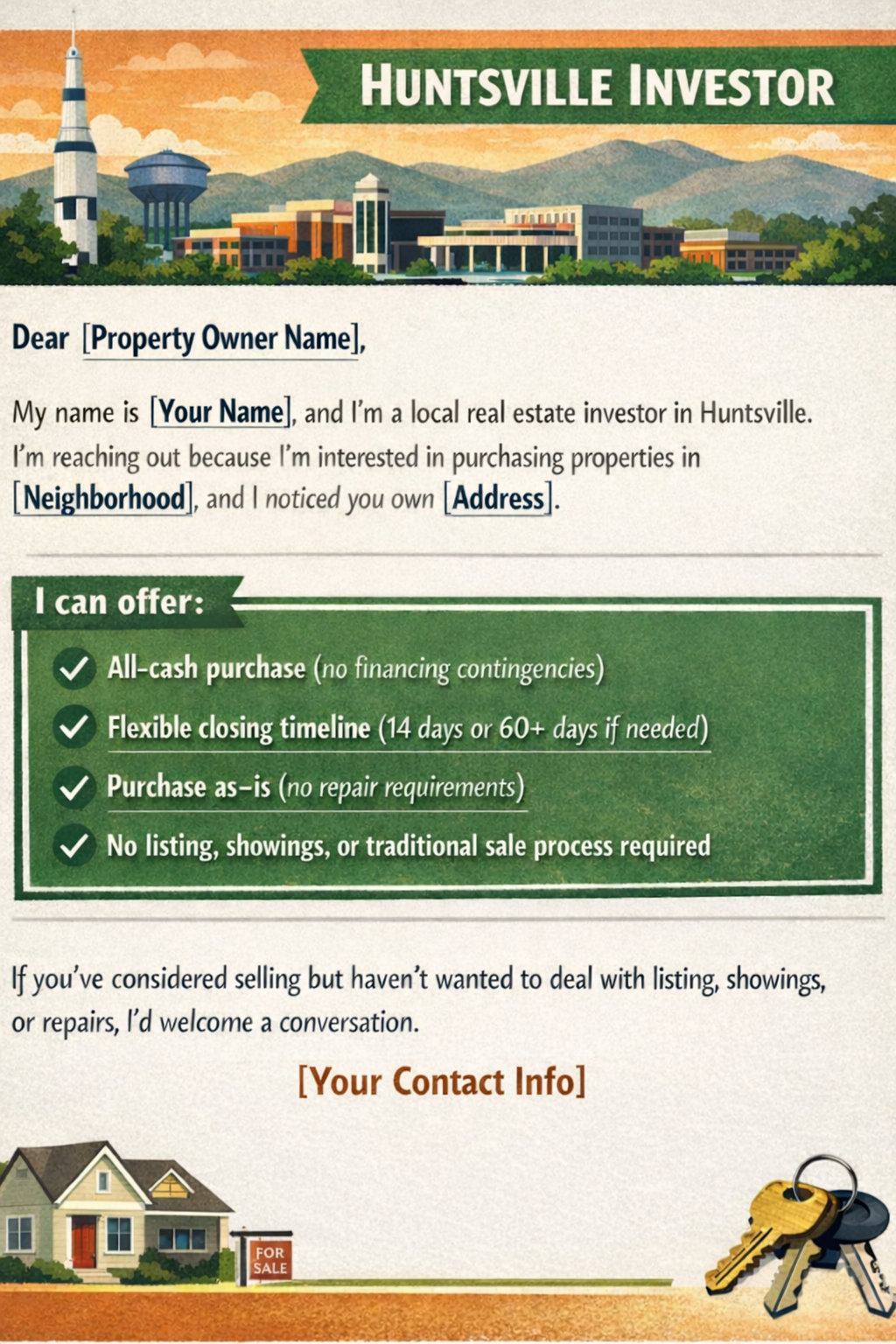
Key elements: Personalization (name, specific address), local presence, no pressure, specific benefits addressing pain points, professional presentation.
Mailing Frequency & Expected Results
Mail 4 times over 10 weeks (initial, 3 weeks later, 6 weeks, 10 weeks), then pause for 3 months and restart.
Expected results:
1-2% response rate is typical
0.5-1% conversion to deals
1,000 mailings = 10-20 responses = 5-10 deals
Budget: $750-1,500 for 1,000-piece campaign. If you acquire one property at $20,000 below market, your ROI is 1,333-2,567%.
Most property owners aren't actively thinking about selling until something triggers the decision. Your letter arrives when they're frustrated with a problem tenant, considering retirement, or dealing with unexpected life changes—timing and frequency matter.
Strategy #2: Driving for Dollars
Driving for dollars means physically driving target neighborhoods looking for properties showing signs of distress, neglect, or vacancy.
What You're Looking For
Overgrown yards (grass over 12 inches, dead landscaping)
Boarded windows or doors
Peeling paint, damaged siding, and deteriorating roofs
Code violation notices posted on doors
"For Rent" signs up for months
Accumulated mail, newspapers, and packages
Visible neglect signals owner problems—financial distress, out-of-state absentee owners, inherited properties no one wants, or overwhelmed landlords.
Target Neighborhoods
Focus on areas matching your investment criteria:
South Huntsville (south of Airport Road)
Downtown peripheral areas
Areas surrounding Redstone Arsenal gates
Older 1960s-1980s construction zones
Technology Tools
DealMachine app ($49/month) - Take photos, app pulls owner info, can send mailers
County GIS systems - Cross-reference addresses with ownership data
Google Earth - Pre-scout virtually before driving
Contacting Owners
Look up ownership via the Madison County Revenue Commissioner website or services like PropStream ($100/month). Send personalized mail or make direct contact.
By being the first conversation owners have about selling, you're establishing relationships without competition. Many owners of distressed properties feel embarrassed about the condition and dread listings—your "as-is" offer removes that anxiety.
Strategy #3: Networking
Off-market deals flow through relationships. The more people who know you're an active, credible buyer, the more opportunities you will find.
Who to Network With
Real estate agents (especially us): Agents hear about potential off-market opportunities before they hit MLS. At Rebecca Lowrey Group, we're contacted monthly by property owners considering selling without listing. Being on our off-market opportunity list gives you access before the general market.
Property managers: They know which owners are frustrated, which properties are chronic problems, and which landlords are considering selling. Build relationships with 3-5 local companies.
Estate and divorce attorneys: Handle inherited properties and divorce situations requiring quick sales.
Contractors and handymen: Hear "I just want to sell this place" regularly from overwhelmed owners.
Other investors: Local real estate investment groups (REIAs) create deal flow. Investors often find properties that don't match their criteria but might match yours.
Where to Network
Madison County Real Estate Investors Association - Monthly meetings
Chamber of Commerce events - Connect with attorneys, CPAs, and financial advisors
NARPM local chapters (narpm.org) - Property manager associations
How to Position Yourself
Be specific: "I'm actively looking for single-family rentals in South Huntsville and Madison, $200,000-350,000 range, that need updating. I can close in 14-30 days with all cash."
Specificity helps people immediately think, "I know someone with a property like that."
Once you're established as a credible, active buyer in Huntsville's investment community, opportunities will come to you instead of you constantly hunting. Investors who invest 10 hours per month in networking receive 3-5 off-market opportunities annually through relationship referrals.
Strategy #4: Wholesalers and Assignment Contracts
Wholesalers find off-market properties, get them under contract, then assign those contracts to end buyers like you. They handle the marketing and initial negotiation; you pay a finder's fee and close.
How It Works
Wholesaler finds motivated seller
Wholesaler negotiates contract below market (Example: $180,000 on property worth $250,000)
Wholesaler markets to investors for an assignment fee (Example: You pay $200,000 - $20,000 to the wholesaler, $180,000 to the seller)
You close, the wholesaler gets paid at closing
Pros and Cons
Benefits: Someone else did the marketing and negotiation. Active wholesalers may present 5-10 opportunities monthly. Quick closings common.
Drawbacks: Assignment fees add a $10,000-30,000 cost, reducing profit. Quality varies dramatically. High-pressure tactics common. Properties often rougher than expected.
Finding Reputable Wholesalers
Attend local investor meetings
Ask experienced investors for recommendations
Join Huntsville real estate investing Facebook groups
Build relationships with wholesalers who bring good deals
Red Flags
Inflated ARV (After Repair Value)
Underestimated repair costs
No property access for inspections
Pressure tactics ("decide today")
Won't disclose the assignment fee
Always run your own due diligence: Comparable sales analysis, multiple contractor estimates, title search, verify zoning, and calculate conservative numbers.
Good wholesalers solve a real problem—they have time and systems to find deals, and you have capital to buy them. The key is working with reputable wholesalers and being disciplined enough to pass on marginal opportunities.
Strategy #5: Expired and Withdrawn Listings
Properties that failed to sell on MLS are excellent off-market opportunities. The seller was motivated enough to list, but something went wrong—overpricing, poor marketing, property condition, or bad timing.
Why This Works
Seller motivation proven: They already tried to sell, indicating real motivation.
Less competition: Most investors ignore expired listings, assuming something's wrong. Often, it just means price or marketing was off.
Negotiating leverage: Failed listings damage seller confidence—you provide the solution.
No listing commission: If the listing has expired and the agent contract is over, potentially save 3-6%.
How to Find Expired Listings
MLS access (agents only): Filter for expired listings from past 30-90 days.
At Rebecca Lowrey Group, we regularly monitor expired listings for investor clients. When a property matching your criteria expires, we reach out before other investors know the listing failed.
Public records alternative: Watch Zillow and Realtor.com for properties that disappear after being listed.
Approaching Sellers
Contact within 1-2 weeks of expiration while frustration is fresh:
"Hi [Seller], I noticed your property at [Address] was listed recently. I'm a local investor interested in potentially purchasing it. Would you be open to discussing a direct sale?"
Offer solutions:
If overpriced: "I can offer [market price based on comps]."
If condition issues: "I'm prepared to buy as-is and handle all repairs."
If timing is wrong: "I can close on your timeline—30 days or 90 days."
Sellers with expired listings have already mentally committed to selling. You're offering a solution eliminating traditional listing hassles. Many gladly accept 5-10% below the original list price for certainty and convenience.

Strategy #6: Pre-Foreclosure Properties
Properties in pre-foreclosure and those with tax liens represent opportunities to help distressed owners while acquiring properties below market value.
Important Ethical Note
Approaching distressed owners requires sensitivity and integrity. These are people facing genuine financial hardship. Your goal should be to provide a solution that helps them avoid foreclosure while allowing you to acquire property. Approach with empathy, transparency, and fair dealing.
How to Find Pre-Foreclosure Properties
Public records: Madison County Circuit Court maintains foreclosure filing records
Foreclosure data services ($50-150/month): RealtyTrac, Foreclosure.com, ForeclosureDaily
Tax lien sales: Madison County annual sales (madisoncountyrevenue.com)
How to Approach
"I noticed there's a foreclosure filing on your property. I'm a local investor, and I'm wondering if you'd be interested in discussing a sale that could help you avoid foreclosure and protect your credit."
Explain the benefits they receive:
Avoid foreclosure on credit report (200-300 point damage, stays 7 years)
Potential to walk away with cash if there's equity
Stop stress and collection calls
Avoid deficiency judgments
Be transparent about your offer: Explain how you calculated it, what market value is, what repairs are needed, and your profit margin.
By providing clear solutions with concrete benefits, you solve their problem while acquiring property. The key is approaching with genuine intent to help, not exploit.

Working with Rebecca Lowrey Group for Off-Market Opportunities
While you can pursue off-market properties independently, working with experienced local agents dramatically increases success.
Why Our Off-Market Network Matters
We're contacted monthly by sellers considering off-market sales. Property owners who know us from past transactions, referrals, or our 340+ five-star reviews ask, "Do you know anyone who might want to buy my rental without listing it?" These opportunities never hit MLS. We connect them with qualified investor buyers in our network.
We monitor expired and withdrawn listings daily through MLS access that individual investors don't have.
We have relationships with every major property management company in Huntsville. Property managers tell us when landlord clients are considering selling.
We're connected to the local investor community through investor meetings and ongoing transactions. Other investors bring us deals that don't fit their model.
We've actually closed investment property transactions in Huntsville and Madison County. Our track record means sellers trust us to close quickly and professionally.
What We Bring
Professional negotiation representing your interests
Accurate property valuation with comprehensive CMA
Transaction coordination (inspections, title work, closing details)
Due diligence support (identify issues, contractor connections)
Credibility with sellers (our reputation gives them confidence)
Common Off-Market Mistakes to Avoid
Mistake #1: No Inspection on "As-Is" Purchases
That $500 inspection protects you from $30,000 foundation issues, $15,000 roof replacements, or $8,000 HVAC failures. Always inspect, even on as-is purchases.
Mistake #2: Trusting Seller Repair Estimates
Walk properties with 2-3 licensed contractors. Get written estimates. Add 20% contingency. Use the highest estimate, not the lowest.
Mistake #3: Overpaying Because "It's Off-Market"
Run comparative market analysis on every opportunity. Is this property priced 10-20% below recent comps? If not, it's not really an off-market deal.
Mistake #4: No Title Search
Always order a title search ($200-400) before closing. Cheap insurance against catastrophic title issues.
Mistake #5: Moving Too Fast
Quality off-market deals withstand normal due diligence (7-14 days). If sellers won't allow a reasonable review, walk away.
Legal Considerations
Wholesaling in Alabama
According to the Alabama Real Estate Commission (AREC) regulations, you don't need a real estate license to wholesale properties if you're selling the equitable interest in a contract (not marketing the property itself). However, regularly buying and selling properties as a business may require licensing. Consult a real estate attorney if planning to wholesale regularly.
Fair Dealing with Distressed Sellers
Provide written offers
Allow time for sellers to consult professionals
Disclose your role clearly
Offer fair value (unconscionable contracts can be voided)
Your 90-Day Action Plan
Days 1-30:
Define investment criteria
Set up financing or proof of funds
Build your team (agent, contractors, inspector, attorney)
Join a local Investor Group
Compile initial direct mail list
Days 31-60:
Send first direct mail campaign (500-1,000 pieces)
Begin driving for dollars (2-3 hours weekly)
Meet with 3-5 property managers
Connect with 2-3 wholesalers
Contact Rebecca Lowrey Group for our off-market list
Days 61-90:
Send a second direct mail campaign
Follow up on responses
Continue driving for dollars
Attend a second local investor meeting
Review and analyze any opportunities
Days 90+:
Monthly direct mail
Weekly driving
Monthly networking
Quarterly professional network check-ins
Most investors fail because they try one strategy for two weeks, don't see immediate results, and quit. Investors who succeed commit to systematic execution over 6-12 months, building processes that generate consistent deal flow.
Bottom Line
Off-market properties aren't mysterious. They're the result of consistent effort using proven strategies—direct mail, driving for dollars, networking, working with wholesalers, targeting expired listings, and helping distressed sellers.
The investors who build successful Huntsville portfolios aren't refreshing Zillow, hoping for deals. They're sending mailers, building relationships, attending networking events, and working with local agents who understand off-market deal flow.
Whether you implement these strategies independently or work with us to access our off-market network, the key is taking action. Start with one strategy this month. Master it. Add a second next month. Build systems that compound over time.
Ready to find off-market properties in Huntsville?
Jessica Hardin | Rebecca Lowrey Group | RE/MAX Distinctive
Top 1% Nationally | 340+ Five-Star Reviews
Huntsville Investment Property Specialists
Information current as of March 2026. Real estate investment carries risk. Always conduct independent due diligence and consult with financial, legal, and tax professionals. Off-market property acquisition requires compliance with Alabama real estate laws and ethical business practices.