If you’re thinking about selling your home in Huntsville, one of the first questions you’ll probably have is: What should we list it for?
It’s an important question, especially in a market where asking prices have been moving around.
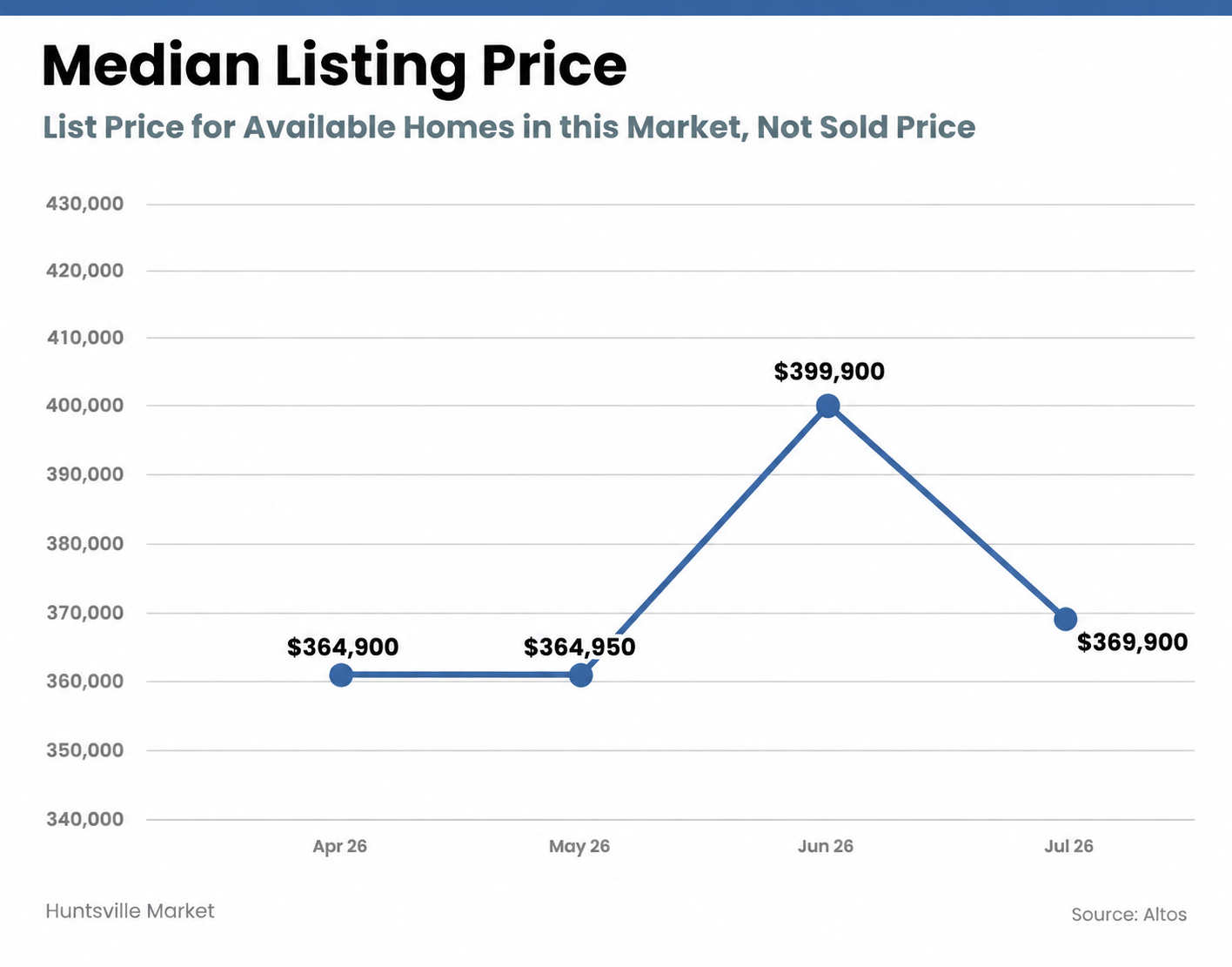
Recent Huntsville data shows the median asking price moving from the mid-$360s to nearly $400,000, then back into the upper $360s. But that doesn’t mean your home should automatically be priced anywhere near the citywide median.
The right listing price depends on your home, recent comparable sales, what else is for sale, current market conditions, and what you want to accomplish with the sale. In fact, the National Association of REALTORS® explains that pricing a home involves looking at the property itself, comparable sales, current market conditions, and the seller’s goals and timeline.
How Is a Listing Price Determined in Huntsville?
A good pricing strategy starts by narrowing the market down to homes that are actually comparable to yours.
That means looking at things like recent sales of similar homes, homes currently for sale, pending sales when useful data is available, and how those properties compare with yours in location, size, condition, updates, lot, layout, and features.
These comparable properties, or “comps,” help build a Comparative Market Analysis, commonly called a CMA. According to the National Association of REALTORS®, a CMA can consider similar properties that have recently sold, are under contract, or are currently active.
The goal isn’t simply to find another house that looks like yours and copy its price. It’s to understand where your home fits among both the sales the market has already supported and the choices available today.
That’s why a citywide statistic can help us understand the overall Huntsville real estate market, but it can’t tell us exactly what an individual home should be listed for.
Why Do Recent Sold Homes Matter When Pricing Your Home?
Recent comparable sales are an important part of determining a listing price because they give us real-world information about what similar homes have actually sold for.
For example, if several homes similar to yours have recently sold within a certain range, that gives us a starting point for understanding what the market has supported.
Realtor.com’s explanation of real estate comps also notes that useful comps should account for similarities such as location, size, features, and other property-specific characteristics, rather than simply choosing homes because they're nearby.
But sold homes are only part of the picture.
A home that sold a few months ago tells us what happened then. We also need to know what someone considering your home will see now.
Why Do Current Listings Matter Too?
Current listings help us see how similar homes are being priced today and what other choices are available in your area and price range.
Imagine someone finds your home online and then looks at three similar properties nearby. How does your price compare? What condition are those homes in? Have they been updated? Do they offer features your home doesn’t, or does your home offer something they don't?
Those comparisons can influence which homes get attention.
That’s why pricing isn’t just about looking backward at sold comps. Recent sales help us understand what the market has supported, while current listings help us understand how your home fits into the market today.
Is Asking Price the Same as Sold Price?
No, and this is an important distinction when you’re looking at the market. An asking price shows where a seller has chosen to position a home. The eventual sold price gives us additional information about what someone was actually willing to pay for it.
That doesn’t make asking prices unimportant. Asking prices and sold prices simply tell us different things.
This difference is especially relevant in the current market. Realtor.com’s 2026 research on the journey from initial listing price to final sale price found that homes nationally have recently been selling for less than asking price on average, a shift from the above-asking-price environment seen during the post-pandemic buying frenzy. That’s another reason we want to look at the whole picture instead of focusing on one number.
Should You List Your Huntsville Home High to Leave Room to Negotiate?
It can be tempting to start high and lower the price later if needed, but that strategy can have drawbacks.
When people have several similar homes to choose from, they can compare price, condition, location, and features quickly. If a home appears overpriced compared with other options, some may simply keep looking rather than make a lower offer.
And the initial price can be especially important. Realtor.com’s June 2026 pricing research found that the first few weeks of a listing can play an important role in whether a home ultimately needs a price reduction.
We’ve also taken a closer look at Huntsville home price reductions and what they can tell sellers about pricing strategy. The goal isn’t to price your home low. It’s to choose a starting price that makes sense based on the property, the market, and your goals.
Does Your Selling Timeline Affect Your Listing Price?
It can. Two homeowners with similar properties may have completely different priorities. One may need to move within a certain timeframe, while another may have more flexibility.
That can be part of the pricing conversation too. The National Association of REALTORS® notes that a seller’s goals and timeline can factor into an agent’s recommended listing price.
That’s why pricing shouldn’t start with a generic online estimate or a single Huntsville statistic. It should start with your home, the market around it, and what you need from the sale.
What Should You Know Before Setting Your Listing Price?
Before deciding on a price, we want a clear picture of three things:
What has sold. Recent comparable sales help us understand what the market has supported.
What’s available now. Current listings help show what other options are available to someone considering your home.
How your home compares. Location, condition, size, updates, layout, lot, features, and other property-specific details can all affect where your home fits.
Put those pieces together, and you have a much stronger foundation for choosing a listing price.
Frequently Asked Questions About Pricing a Home in Huntsville
How do Realtors determine a listing price?
Real estate agents typically use a Comparative Market Analysis, or CMA, along with their knowledge of the local market. A CMA can include recently sold comparable properties, current listings, pending sales, market conditions, and the characteristics of the home itself. NAR provides a helpful overview of what goes into pricing a home here.
What are comps in real estate?
“Comps” are comparable properties used to help evaluate where a home may fit in the market. Relevant comps generally share characteristics with the home being evaluated, such as location, size, condition, age, amenities, and features.
Should I price my home based on what my neighbor listed theirs for?
Not necessarily. Their asking price tells you what they decided to ask, but it doesn't tell you what the home will ultimately sell for. Your home may also differ in condition, size, updates, lot, layout, or other features.
Does the Huntsville median asking price determine what my home is worth?
No. The median asking price helps us understand broader Huntsville pricing trends, but it doesn't determine the value or recommended listing price of an individual property. Your home needs to be evaluated using relevant comparable properties and current market conditions.
Can I start with a higher price and reduce it later?
You can, but there can be trade-offs. Starting too high may affect early interest and could eventually lead to a price reduction. Nationally, Realtor.com reported that 20% of active listings had experienced a price cut in July 2026, although individual markets and properties can behave very differently.
Your Home Needs Its Own Pricing Strategy
The Huntsville housing market gives us important information, but your home isn't the Huntsville median.
If you’re thinking about selling, your pricing strategy starts before your home ever hits the market. We’ll look at the numbers, talk about your goals, and determine where your home fits in today’s market so you can make an informed decision from day one.
Rebecca Lowrey | Rebecca Lowrey Group | RE/MAX Distinctive | Top 1% Nationally | 350+ Five-Star Reviews | Huntsville, Madison & North Alabama Real Estate Specialists
Market conditions, pricing trends, and inventory can change frequently. Information is provided as a general market snapshot and should not be considered a valuation of any individual property. For a property-specific pricing analysis, consult a qualified real estate professional. Information current as of September 2026.